Page 1 of 2 12 LastLast
Results 1 to 10 of 13

Thread: engine speed from the alternator

  1. #1
    Join Date
    Jan 2011
    Location
    Burpengary, QLD
    Posts
    620
    Total Downloaded
    0

    engine speed from the alternator

    Hello people

    I have a 2.8 tgv engine (big 300tdi, sort of) in my P38 and I was wondering if it's possible to give the computer the engine speed signal from the back of the alternator, discovery style.

    I will happily admit that I don't have a great deal of idea what kind of signal the crank position sensor puts out but does anyone know if it's the kind of signal it's easy to replace.

    I currently have a crank position sensor and the standard ring of tabs but the design of the sump doesn't make it easy to replace the sensor so as I thought I'd look into options.

    Thanks in advance for any information

  2. #2
    p38arover's Avatar
    p38arover is offline Major part of the heart and soul of AULRO.com
    Administrator
    I'm here to help you!
    Gold Subscriber
    Join Date
    Jan 1970
    Location
    Western Sydney
    Posts
    30,806
    Total Downloaded
    1.63 MB
    As the P38A gets its rev info from the engine management system, it should be easy to replicate that with a signal from the tacho.

    Tachometer
    The tachometer will display the engine speed in R.P.M. It will derive the engine speed from the engine speed pulse train transmitted from the Engine Control Module (ECM) (Z132).
    The pulse rate for petrol engines will be 4 pulses per engine revolution.
    The pulse rate for diesel engines will be 3 pulses per engine revolution.
    I assume the pulses/rev relate to the no. of cylinders.

    If there is a W terminal on the alternator, one could pick that up, amplify and square it, put it through an appropriate divider (counter) to give 4 pulses per rev (to emulate what used to come from a V8) to the instrument pack.

    How many pulses per rev from the alternator? See here: http://www.ybw.com/forums/showthread...-on-Alternator
    Ron B.
    VK2OTC

    2003 L322 Range Rover Vogue 4.4 V8 Auto
    2007 Yamaha XJR1300
    Previous: 1983, 1986 RRC; 1995, 1996 P38A; 1995 Disco1; 1984 V8 County 110; Series IIA


    RIP Bucko - Riding on Forever

  3. #3
    Join Date
    May 2010
    Location
    Mindarie, Western Australia
    Posts
    1,141
    Total Downloaded
    0
    Ron, you make it sound so easy.

    Gary

  4. #4
    p38arover's Avatar
    p38arover is offline Major part of the heart and soul of AULRO.com
    Administrator
    I'm here to help you!
    Gold Subscriber
    Join Date
    Jan 1970
    Location
    Western Sydney
    Posts
    30,806
    Total Downloaded
    1.63 MB
    That's the trouble with being an ex-electronics tech - I can make it sound easy.

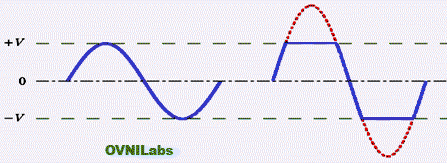
    The output of the W terminal is AC sine wave. If it is amplified, one can clip it to square the signal. We'd then have a square wave at a frequency proportional to alternator RPM.

    In this image, you can see how the square wave can be generated from a clipped sine wave. It would need a bit more amplification and clipping to square it up.


    We'd need to know the ratio between the alternator pulley and the engine pulley and the number of poles in the alternator (see the link above) to work out how many pulses per minute we get from the square wave at a particular engine speed.

    We know we need 4 pulses per revolution of the engine, so we'd run the square wave through a counter (divider) circuit. For example, let's assume the square wave gave 40 pulses per revolution of the engine*, we'd divide that by 10 to get 4 pulses per rev. Where it gets tricky is when the division isn't a whole number but one might be happy to live with a small error.

    * I have no idea how many there would be.

    See also VDO Tacho wiring
    Ron B.
    VK2OTC

    2003 L322 Range Rover Vogue 4.4 V8 Auto
    2007 Yamaha XJR1300
    Previous: 1983, 1986 RRC; 1995, 1996 P38A; 1995 Disco1; 1984 V8 County 110; Series IIA


    RIP Bucko - Riding on Forever

  5. #5
    Join Date
    Jan 2011
    Location
    Burpengary, QLD
    Posts
    620
    Total Downloaded
    0
    You explained that so clearly even I understood it, no small achievement.

    I am very happy to hear someone who clearly knows their stuff say it's possible but it sounds like something I will have to get some help with, I'm a metalworker so if I can't use a lump hammer or an angle grinder it's a bit delicate for me.

    Now I know it's possible I will get some research done.

    would an electronic magic box to clip the ac wave and counter be off the shelf kind of stuff or is it a self assembly job?

    thanks for the help, just making it sound reasonable is a great help

  6. #6
    Join Date
    Jan 2011
    Location
    Burpengary, QLD
    Posts
    620
    Total Downloaded
    0
    so it would seem the alternator has 12 poles in 6 pairs, should make getting back to 4 pulses per rev an interesting exercise but at least I can start trying to work it out so I know what to ask for when I'm ready to give it a go.

    Thanks again for all your help

  7. #7
    p38arover's Avatar
    p38arover is offline Major part of the heart and soul of AULRO.com
    Administrator
    I'm here to help you!
    Gold Subscriber
    Join Date
    Jan 1970
    Location
    Western Sydney
    Posts
    30,806
    Total Downloaded
    1.63 MB
    An easy way to get a tacho but not as elegant would be to just fit a VDO unit that takes the W signal and is adjustable.
    Ron B.
    VK2OTC

    2003 L322 Range Rover Vogue 4.4 V8 Auto
    2007 Yamaha XJR1300
    Previous: 1983, 1986 RRC; 1995, 1996 P38A; 1995 Disco1; 1984 V8 County 110; Series IIA


    RIP Bucko - Riding on Forever

  8. #8
    Join Date
    Jan 2011
    Location
    Burpengary, QLD
    Posts
    620
    Total Downloaded
    0
    I am hoping to be able to replace the crank position sensor input, my rev counter works at the moment but gets a bit wild after 2500-3000rpm, due to the engine swap replacing the sensor is not that easy so I was hoping the w post on the alternator might give me an alternative.

    I am not sure if the gearbox computer uses the same signal from the ecu to know engine speed for gear changes also.

  9. #9
    p38arover's Avatar
    p38arover is offline Major part of the heart and soul of AULRO.com
    Administrator
    I'm here to help you!
    Gold Subscriber
    Join Date
    Jan 1970
    Location
    Western Sydney
    Posts
    30,806
    Total Downloaded
    1.63 MB
    Do the 300Tdi engines have a crank position sensor? A crank position sensor will probably have a missing pulse each revolution - like this (Image from my P38A after it damaged the fingers on the flywheel, hence the irregular pulse heights):

    From another thread of mine:

    Quote Originally Posted by p38arover
    So this arvo I put an oscilloscope on the output of the crank angle sensor.

    This is what it looked like.


    From the left (disregarding the first spike), the first pulse with the different shape is the one that sets up the timing. The reluctor ring has a missing tooth (intentional) to to identify TDC on no. 1 cylinder. Those pulses are 10 degrees apart - there's 35 pairs of teeth (don't forget there's a missing tooth to make up the 36 needed).
    From the workshop manual:

    The output signal from the CKP sensor is obtained from the magnetic path being made and broken as the reluctor ring teeth pass the sensor tip. The reluctor ring has 35 teeth and one missing tooth spaced at 10° intervals. The missing tooth is positioned at 20° after TDC.

    Ron B.
    VK2OTC

    2003 L322 Range Rover Vogue 4.4 V8 Auto
    2007 Yamaha XJR1300
    Previous: 1983, 1986 RRC; 1995, 1996 P38A; 1995 Disco1; 1984 V8 County 110; Series IIA


    RIP Bucko - Riding on Forever

  10. #10
    Join Date
    Apr 2009
    Location
    Crafers West South Australia
    Posts
    11,732
    Total Downloaded
    0
    Could you install a pickup inside the timing cover to count the teeth of a timing pulley? There are also plenty of crank pulleys with timing teeth on them, a wheel with the correct number of teeth could be attached to the back of the front pulley.

Page 1 of 2 12 LastLast

Bookmarks

Bookmarks

Posting Permissions

  • You may not post new threads
  • You may not post replies
  • You may not post attachments
  • You may not edit your posts
  •  
Search AULRO.com ONLY!
Search All the Web!