White Cliffs Solar Power Station is Australia's first solar power station. It is located at White Cliffs, New South Wales, which was chosen as it has the highest insolation in New South Wales, and in 1981 when the station was constructed had no grid connection.
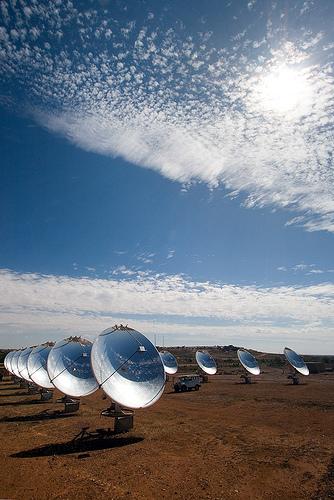
Constructed by a team from Australian National University, the station consisted of fourteen three-metre parabolic dishes, each covered by more than 2000 mirrors and mounted on a heliostatic mounting. The dishes each focussed the sun's rays on a collector, where water was boiled. The resulting steam drove a three cylinder Uniflow steam engine, made by modifying a Lister diesel engine, delivering up to 25kWe. Batteries were used to provide 24 hour power to selected buildings in the township, and an existing diesel generator retained to provide battery charging when either low insolation or strong winds prevented use of the solar station for extended periods.
In 1996, following grid connection of the township, the station was converted to photovoltaic. The dishes were resurfaced, and the original collectors each replaced by a cluster of 16 water-cooled photovoltaic cells. In its new form, the station delivers up to 45kWe. The steam engine, batteries, and diesel generator were removed, and the output fed into the grid.
The grid connected power station ran for around 6 years, generating valuable data on the long-term performance and efficiency of the modules. The power station ceased operation in December 2004 and has been resumed by the owner of the site.


 Master
You see a lot of people pull the camera out, snap a quick shot from eye-level then disappear - without considering different angles or elevations.

 Posting Permissions

 Reply With Quote
Bookmarks