Results 1 to 10 of 10

Thread: 240 v generators

  1. #1
    Ean Austral Guest

    240 v generators

    Gday All,


    After another wonderful blackout where all of Darwin had no power at all for atleast 12 hours its time to look at some form of back up power.


    I hooked up my 1.5kva genny to run the fridge/freezer and the fish tank( got a big fish tank at home and didn't want to have to replace any fish as they aint cheap ) BUT the 1.5 really only has 1200w continuous I am thinking I need something bigger.


    Been doing a bit of reading, but the generators seem to be not as they seem, 4.4kva but only 2800w but some are 4.4kva and between 3000-3400w.


    So my question is seeing we are sooner or later going to get a cyclone that hits , and with a very unreliable power grid, what size would I need to say
    Keep the fridge/freezer going
    run a few things like the fish tank and a couple of fans.
    plus have a bit for incedentals.


    Not worried about kettle/microwave etc as have gas on the BBQ for cooking/boiling water.


    Can anyone give me an idea on the Kva / watts as this seems to be the key to the power supply.


    Cheers Ean

  2. #2
    Join Date
    Apr 2009
    Location
    Crafers West South Australia
    Posts
    11,732
    Total Downloaded
    0
    Ean, the real problem is that generators need to be big enough to start any load but after that they often run for long times at light loads. (and they're noisy) If your heart is set on a genny you would be best with a 4-5kVa but personally I prefer having a battery bank and an inverter of a similar size. If your inverter/battery set is the same voltage as a vehicle in your fleet you can run jumper leads off the vehicle to top up the battery after a long blackout, or have an "outback power" style 12VDC generator. The rest of the time you keep the battery topped up with its own intelligent battery charger so it is always ready to use. Camping solar panels can earn their keep too.

  3. #3
    Ean Austral Guest
    Quote Originally Posted by bee utey View Post
    Ean, the real problem is that generators need to be big enough to start any load but after that they often run for long times at light loads. (and they're noisy) If your heart is set on a genny you would be best with a 4-5kVa but personally I prefer having a battery bank and an inverter of a similar size. If your inverter/battery set is the same voltage as a vehicle in your fleet you can run jumper leads off the vehicle to top up the battery after a long blackout, or have an "outback power" style 12VDC generator. The rest of the time you keep the battery topped up with its own intelligent battery charger so it is always ready to use. Camping solar panels can earn their keep too.
    Never thought of that type of set up


    So are you saying a 5000w inverter or bigger and just a continuous charge to the batteries.
    That set-up would suit me personally, as its nice and simple and quiet. I assume that inverters work the same as a genny in the power output equasions?


    Cheers Ean

  4. #4
    Join Date
    May 2006
    Location
    Woolgoolga
    Posts
    7,870
    Total Downloaded
    0
    Yeah but you need a decent set of batteries to run that stuff, genie is much easier for what you want to do, and cheaper. I'd look around 6kva, and if you want to spend the extra money, go diesel!
    (I've set up a few houses and shacks with stand alone solar, never as great as it sounds, and rather costly, and how do you charge it at night? Oh you use your generator!)

  5. #5
    Join Date
    Apr 2009
    Location
    Crafers West South Australia
    Posts
    11,732
    Total Downloaded
    0
    Quote Originally Posted by Ean Austral View Post
    Never thought of that type of set up


    So are you saying a 5000w inverter or bigger and just a continuous charge to the batteries.
    That set-up would suit me personally, as its nice and simple and quiet. I assume that inverters work the same as a genny in the power output equasions?


    Cheers Ean
    Everything depends on the quality of the unit. El cheapo inverters are rated rather generously.

    Example: Many years ago when I first dabbled in inverter stuff I purchased a "quality" Jaycar brand 1000W/2000W surge rated sine wave inverter for the work car. While it ran the 650W variable speed power drill no worries it couldn't get my 4 1/2" angle grinder going without tripping out. Later I saw a run-out model Australian made "Selectronic" 400W inverter on ebay and grabbed it. This unit quite happily starts and runs the same angle grinder, also starts and runs the household water pressure pump with a bit of a struggle but it gets there. Now the Selectronic inverter is rated at a 1200W surge rating, much lower than the Jaycar unit but it can do that and more without any BS. The difference is that the good inverter rates its surge in minutes, not milliseconds.

    If money's no object, I reckon the gold standard of backup is a Selectronic battery backed solar system. Totally automatic in operation if built correctly. I'll never afford it but my modest 1200W Selectronic inverter covers my needs well enough on a 12V 300Ah battery bank. It'll run the Vestfrost eco fridge, small freezer, led lights evap a/c and the telly for a few hours depending on sunshine input or charger input. None of those appliances has a big running load but all require a bit of grunt to start.

  6. #6
    Join Date
    Aug 2007
    Location
    Bunbury, WA
    Posts
    2,507
    Total Downloaded
    0
    I recently bought a 5.9kVa Gentech generator for similar reasons to you, plus to run my pumps for fire protection.

    I seriously considered the battery/inverter route, but to get say 3kW out of an inverter, you need approx 300 amps at 12v going in (assuming minimal losses)? That is going to need some serious battery storage to run for any period of time. A generator was the simplest, low maintenance, most cost effective way to achieve the backup power I needed.

  7. #7
    Join Date
    Dec 2006
    Location
    Torres Straits
    Posts
    3,502
    Total Downloaded
    0
    Ean,
    we also have unreliable power
    A honda 2kva will run 2 deep freezers (1 140L upright one 240L chest) 2 standard fridges and an engel without a worry in the world - not on eco throttle obviously
    the trick is to not hit them all at once - turn them on with a few minutes between start ups

    last big black out we had (3 days) I think it tripped the overload just the once when all loads got in synch enough to overload on startups

    I got lazy on topping up fuel during that power down and now just run an ebay special fuel cap on the gennie which plugs into the big boats fuel tank (240L) in the carport

    Relatively quiet and easy and cheaoer than a 4-5-6-7-8kva monster

    The new house we are building this year or so will have 12V lighting and ventilation fans from a solar with 5 day battery bank
    Then it will just be the old honda to run the fridges and voila Ergon can go jump when the power goes wonky!

    Steve

  8. #8
    Join Date
    Jan 1970
    Location
    Queensland
    Posts
    7,907
    Total Downloaded
    0
    Hi Ean and I have both a 6kva gen and a small bank of batteries ( 400Ah )

    I bought the generator because of numerous blackouts we get in the Hinterland, just above the Gold Coast, and we tend to have L-O-N-G blackouts.

    Last Feb, we were without power for nearly three days after the cyclone.

    I use the generator to power two large fridges and run an air conditioner and a 40 amp battery charger, plus entertainment and business appliances, during the day and into the evening.

    Then to get rid of the noise at night, I then use a 750w inverter to power a few lights, a Plasma TV and a few other entertainment appliances.

    This set up works well for me.

    BUT, if I did not need ( have ) batteries for my business, I would be using the dual battery system in my 4x4 to achieve the same power supply at night and recharge the batteries during the day, either by driving or with the battery charger powered from the generator.

  9. #9
    Join Date
    Sep 2007
    Posts
    577
    Total Downloaded
    0

    Powering on..

    i agree with the inverter and battery option particularly at night. The house next to mine in PNG was fitted out with a Kubota diesel which would run everything but was a pain in the ars. it was not fitted with a noise suppression hood. I had a 300 watt inverter which ran all that I needed in terms of laptop and lighting and sat tv. Water gravity fed.

    Like a lot of people we ran a small superexpensive genie after the Brisbane flood event but it would only start one fridge/freezer at a time with a manual swap over which was a surprise. If it did not get away on the first start you had to wait about 10 mines otherwise it would stall. Eventually ran on a lead out with the genie under cover outside for 4 days and just kept things going. Gas hot water and cooking helps.

    In storm season we also keep enough fuel on site to run the genie for 5 days. Cycle it over through the vehicles later in the year.

    Business case is out on diesel vs petrol particularly for standby power.


    Ean,

    the apprentice should be able to tong test all the stuff in the house to determine the total load. Just watch the starting current as others have indicated and don't have simultaneous starts. If you have a water pump you may find it's worthwhile having a much smaller standby pump rather than the 4 showers simultaneously capacity as the genie or inverter will struggle on start.

    Cheers and hope your dark moments are reduced.

  10. #10
    Join Date
    Jan 1970
    Location
    Adelaide Hills - SA
    Posts
    12,486
    Total Downloaded
    0
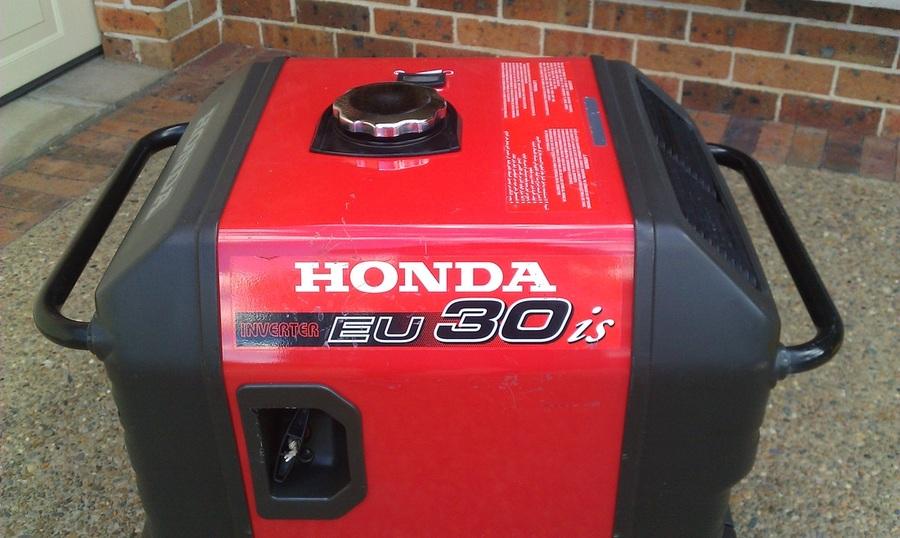
    We wanted something quiet, with more grunt than our little Honda EU20, and went for an EU30is model Honda. The "is" suffix is for (supposedly) silent! It is just as quiet as the EU20 model, if you have heard one of them (they are very common).


    This size gennie has enough grunt to start an airconditioner & etc, but you can still manhandle it around on your own.

    We also looked at the larger 6Kva Honda, but it was getting seriously heavy, at 115Kg. The 3Kva is 55Kg which I can just lift on my own. 115Kg was out of the question! Also the 6Kva was around $6K from memory, so a lot more expensive than the 3Kva, which was around $4K.

    HTH
    David

Bookmarks

Bookmarks

Posting Permissions

  • You may not post new threads
  • You may not post replies
  • You may not post attachments
  • You may not edit your posts
  •  
Search AULRO.com ONLY!
Search All the Web!