Oh yeh Gary is right. Hadn't picked up you said it was an Actual foglight switch. I am using the height inhibit switch in mine. You could probably modify the switch by adding a circuit so the momentary switch latched the circuit until power is turned off but that's getting a little more complex.
Hi folks and this has been an interesting read and here is just a suggestions relating to the type of relay to use.
If you use a diode protected relay, you MUST wire it correctly or you will not only stuff the diode but the relay will be useless as well.
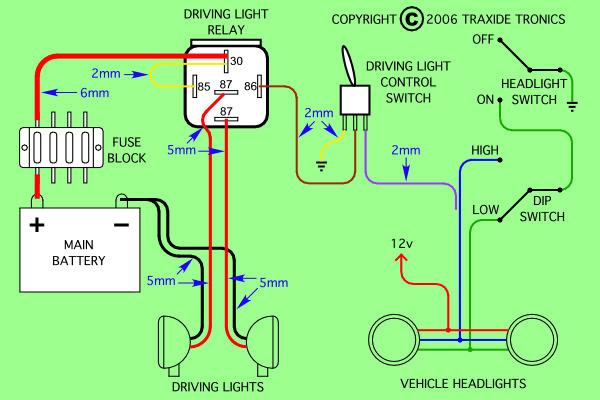
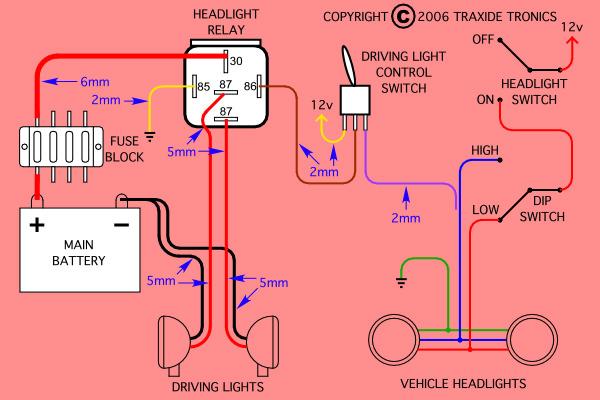
For positive switched headlights, relay pin 85 goes to earth, and the high beam connects to relay pin 87 ( via a switch if required ).
BUT, there is no reason for using a diode protected relay in the first place.
These diode ( spike ) protected relays are designed to reduce EMF, by removing the spike.
There is nothing to be gained in the way of electronics protection if you use one of these relays just as you are not going to risk harming anything if you use a no spike suppressed relay, and most of the relays in vehicles today are not spike protected.
If you already have a relay, spike protected or not, just use it. All your electronics is already protected by built-in protection that is incorporated into every electronic device ever make.
Hi All
Thanks for all the replies and it looks like that I need to get rid of the fog light switch and use an inhibitor switch. If I use the inhibitor switch, do I need a diode relay or just a normal relay.
The connections to the relay have me a little confused. I believe that the #4 post of this thread by WayneG with the wiring diagram shows 86 is the main beam feed and 85 goes to earth. If this is correct, I believe that I can not use the diode relay that I have because it shows the current flows from 85 to 86. I will need a normal relay.
Your opinions are appreciated.
Regards
Kev
Steve
Some clarification (hopefully) courtesy of the RAVE manual
"CIRCUIT OPERATION
Front Fog lamps
With the ignition switch and side lamp or headlamp
switch on, a momentary operation of the front fog
lamp switch will activate the front fog lamps. A further
momentary operation of the fog lamp switch, or
switching off of the headlamps/side lamps or ignition,
will cause the front fog lamps to be extinguished.
N.B. The front fog lamps will always be inactive
when the ignition is turned on."
Gary
HI
The switch we arrived at was STC8889 - Auxiliary lighting switch, which may not be the same as the fog light switch which is listed as AMR3711.
So it seems there are two different switches
Looks like the ride inhibit switch with the fascia changed might be the easiest way to go.
Steve
Hi
To clear up the orientation quesition standards state that 86 is (+) and 85 is earth (-) so it seems my original post was correct after all
It's on the first page of this doc
http://www.hella.com/ePaper/Elektrik...h/document.pdf
Steve
Hi Gary and that diagram is for negative switched headlights.
Correct me but I think the LR headlights are all positive switched and if so this diagram will do the job.
Hi Steve and there is no such thing as a relay wiring “standard”, the info you linked to is for HELLA relays and covers “DIODE” spike suppressing relays which are polarity sensitive.
You can also get “Capacitor/Resistor” which are not polarity sensitive.
And as covered above, the standard relays do not have any spike protection and are not polarity sensitive.
So if you are using a diode spike protected relay, use HELLA’s instructions, but for ordinary relays, you can wire the coil connects, pins 85 and 86, to work in either direction.
For POSITIVE SWITCHED HEADLIGHTS.
PLEASE NOT, the YELLOW wire connected to the switch in both diagrams, is an optional connection and is there to allow the driving lights to be operated without the need to turn the head lights on and to high beam.
![]()
| Search AULRO.com ONLY! |
Search All the Web! |
|---|
|
|
|
Bookmarks